
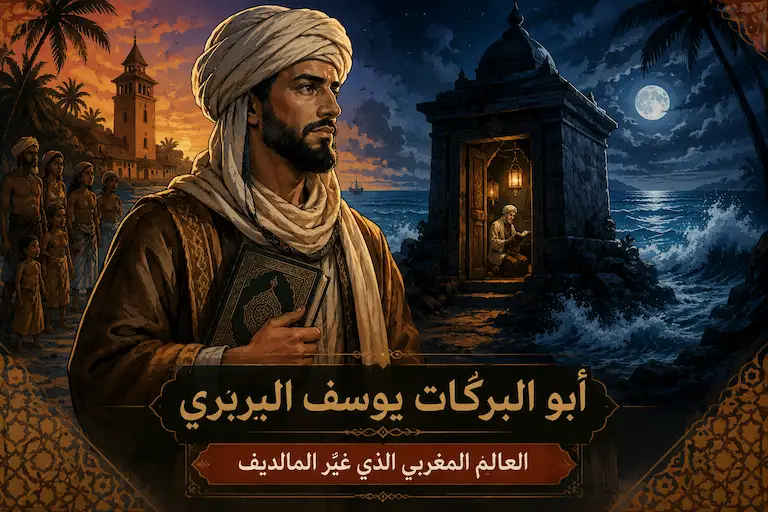
The Moroccan Scholar and the Spirit of the Sea
Written by:Abdou Abdellah
Many centuries ago, before the Maldives became a Muslim land, the people of the islands passed down an old tale that filled every household with dread.
Whenever the full moon returned, they believed that a powerful spirit called **Rannamaari** rose from the sea. To escape its wrath, the king's people chose a young maiden and left her alone in a shrine by the shore. Before sunrise, she was gone.
No family welcomed the night when the sacrifice was due. Yet no one dared question the custom. Their fathers had accepted it, and so had their grandfathers.
It was during those troubled days that a traveler from Morocco reached the islands after a long voyage across the seas. His name was **Abu al-Barakat Yusuf al-Barbari**. Wherever he travelled, people sought his advice, for he was respected as a man of learning and deep faith.
Before long, he noticed the sorrow that hung over the villages.
One evening, as fishermen repaired their nets beneath the fading light, the scholar asked why the people looked so troubled.
An old fisherman sighed.
"Tomorrow night," he said, "the sea will claim another daughter of these islands."
The old man told him everything—the shrine, the sacrifices, and the fear that had ruled the islands for generations.
The following morning, Abu al-Barakat asked to speak with the king.
The king received him with courtesy and repeated the story that every child on the islands already knew.
When the king had finished, the scholar remained silent for a moment before speaking.
"If Your Majesty permits," he said, "send no young woman tomorrow. Allow me to spend the night in the shrine."
The king stared at the stranger.
"Many have feared that place," he said quietly. "Would you enter it willingly?"
Abu al-Barakat answered, "A man's life rests in the hands of God alone."
The king granted his request.
As darkness spread across the island, the palms bent beneath the wind, and the sea pounded against the rocks. The scholar entered the lonely shrine carrying nothing except the Holy Qur'an.
The villagers watched from a distance. No lamp was lit that night. Mothers gathered their children indoors, while the fishermen stood silently along the shore.
Inside the shrine, Abu al-Barakat recited verses from the Qur'an without pause.
Hour after hour, only the wind and the waves answered his voice.
Then the long night passed.
When the first light appeared above the ocean, the doors of the shrine slowly opened.
The scholar stepped outside unharmed.
The people could hardly believe what they saw.
From that day, no more sacrifices were offered at the shrine.
The king invited Abu al-Barakat to remain on the islands and teach him about Islam. After many conversations, the ruler accepted the new faith, and, over the years that followed, the people of the Maldives embraced Islam as well.
Old storytellers in the Maldives still remember the scholar who crossed the sea from Morocco and faced the night alone. Whether every detail belongs to history or to legend, his name has endured for centuries, carried from one generation to the next like the sound of the waves upon the shore.
*Historical Note:* This story is based on a cherished Maldivian tradition. The famous traveler Ibn Battuta identified the scholar as the Moroccan **Abu al-Barakat Yusuf al-Barbari**, while some other historical sources attribute the conversion of the Maldives to the Persian scholar **Yusuf Shams al-Din al-Tabrizi**. Historians continue to debate the question, but the legend of Abu al-Barakat remains one of the best-known stories in the history of the Maldives.
______________________
About This Story
**The Moroccan Scholar Who Silenced the Sea** is inspired by one of the most enduring traditions in the history of the Maldives. According to Maldivian chronicles, a Moroccan scholar named **Abu al-Barakat Yusuf al-Barbari** arrived on the islands during the twelfth century and played a central role in the conversion of the kingdom to Islam. His story combines elements of history, oral tradition, and legend, making it one of the most fascinating accounts linking Morocco to a distant part of the Indian Ocean.
Although historians continue to debate the scholar's exact identity, the legend has been preserved for centuries and remains an important part of Maldivian cultural heritage. It tells of courage, wisdom, and the power of faith in the face of fear, values that have allowed the story to endure through generations.
This adaptation was carefully written for **MoroccoHykayat.com** to introduce modern readers to a remarkable tale that connects Morocco with the wider world. While respecting the traditional narrative, the story has been retold in a style suitable for today's readers, preserving its historical atmosphere and legendary charm.
**Written and adapted by Abdou Abdellah for MoroccoHykayat.com.**