
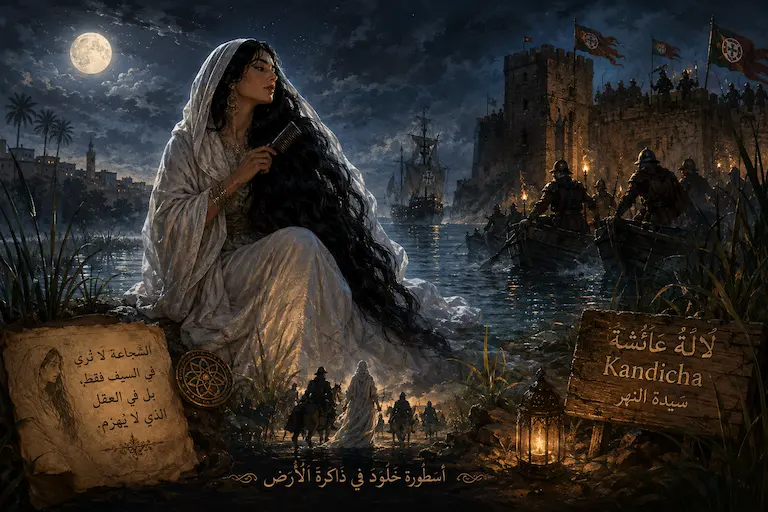
Lalla Aicha Kandicha: The Secret of the River’s Mistress
Traditional Moroccan Folktale — Author Unknown
Adapted and narrated in the style of Morocco Hykayat
"Peace and blessings upon the Chosen Prophet and his noble companions! O honored guests, O people of grace and dignity, weigh my words with a scale of gold and listen to the tale of Lalla Aicha—the one whose name makes the darkness tremble and awakens the sleeping memory of the land.
Once, in a time long past, when Morocco was locked in a fierce struggle with the waves and the wind, the Portuguese ships swarmed our coasts like locusts. In the midst of that turmoil, there lived a young woman in the city of Safi named Aicha. She was a daughter of nobility and prestige; her father was a great scholar, and her family was renowned for their generosity and pure faith. Aicha was a miracle of beauty—her face was like the moon on its fourteenth night, and her eyes held a spark of intelligence that could read the secrets hidden in men's hearts. But the world is a spinning wheel, and on a night devoid of light, the invaders stormed her home. They scattered her kin, burned the harvests and the holy books, and took the lives of everyone Aicha held dear.
From that moment on, Aicha was no longer the laughing girl among her peers. A coal of vengeance was struck in her heart, a fire that nothing could quench. She donned the white haik—the traditional robe of mourning and purity—and vanished into the mountains and the wetlands near the Loukkos and Oum Er-Rbia rivers. There, she began to weave the threads of a game that would cause history to whisper her name for centuries to come.
Imagine with me: the Portuguese soldiers sitting in their cold stone fortresses, fear eating at their hearts in a land whose secrets they did not know. Suddenly, through the mist of the riverbank, a white shadow appears. A woman of breathtaking beauty sits by the water’s edge, combing her long, raven hair that flows down to the earth, singing a melody that pierces the soul. The soldiers, poor fools, believed they were seeing a Contessa—a Countess—lost in the woods. Their foreign tongues struggled with the word, and over time, among the Moroccans, "Contessa" became "Kandicha." They would follow that enchanted vision, lured step by step, from valley to valley and forest to forest, until they reached the treacherous marshes where the earth is like dough—swallowing men and never giving them back.
The rumors grew like storm clouds. A soldier who escaped, trembling with fever, told his comrades that he had glimpsed beneath her robes the hooves of a goat! People began to say she was a Djinnia, the Queen of the Ghouls. But the truth, my listeners, is that Lalla Aicha was far cleverer than these superstitions. It is said she wore goat-hoof shoes to confuse the scouts, making them believe the tracks in the sand belonged to a wild beast rather than a human. She worked in the shadows with the resistance, delivering messages to the fighters and breaking the sieges on the brave men in the dead of night, disguised in that white shroud that terrified the enemy into believing they were fighting a supernatural ghost.
The years passed, the invaders were driven out in defeat, and "Kandicha" remained a living legend. People forgot she was once a woman of flesh and blood and began to see her only as the spirit who haunts abandoned wells. But those who know the history know that Aicha Kandicha is a symbol of the Moroccan woman who refuses to bow her head. She is the "Mistress of the River" who guards the soil and the memory of our ancestors. Even today, when you walk near a marsh at night and hear the rustle of the trees, remember that the spirit of Lalla Aicha is there, guarding her land with a sharp wit and a pride that never dies.
And so, our story travels from one generation to the next, its sweetness lingering in the heart like sugar in a glass of mint tea. May mercy be upon those who rose to fight, and those who left their names engraved in the stones of their country."