Sidi Chamharouch
A Moroccan folktale from the Atlas adapted for Morocco hykayat
High in the vast and ancient Atlas Mountains, where jagged peaks cut into the sky and silence stretches for miles, there are paths known only to shepherds, pilgrims, and the wind. These mountains are not empty. They breathe with stories—old, unseen, and deeply rooted in the hearts of those who live among them.
At the foot of the towering Mount Toubkal, travelers often pass a sacred place unlike any other: the shrine of Sidi Chamharouch. Built around a great white rock beside a rushing mountain stream, the shrine stands in quiet watch over all who cross that path. Pilgrims come seeking healing, protection, or answers. Some whisper prayers, others leave offerings, but all lower their voices, for it is said that Sidi Chamharouch is no ordinary saint. In the old traditions of the High Atlas, he is believed to be a powerful guardian, a ruler among the jinn, watching over the mountains and those who wander through them.
Many years ago, before clear trails and modern maps, a young traveler set out alone toward the high passes near Toubkal. He was not from the mountains, but he had heard stories of their beauty—of valleys blooming in spring and peaks crowned with snow. Confident in his strength, he began his journey at dawn, following a narrow path that wound its way upward.
At first, the road seemed kind. The air was fresh, and the distant villages slowly faded behind him. But as the day wore on, the path became uncertain. Stones shifted under his feet, the wind sharpened, and the familiar signs of passage disappeared. By the time the sun began to sink behind the peaks, the traveler realized he no longer knew where he was.
He turned back, hoping to retrace his steps, but the mountains had changed. Every direction looked the same—endless rock, shadow, and silence. Panic slowly tightened around him as darkness spread across the land. The cold crept in, biting through his clothes, and the night brought with it a heavy stillness.
Alone and afraid, he sank onto a stone and whispered a prayer into the emptiness, though he did not know who might hear it.
Then, through the silence, came a sound.
Soft… steady… unmistakable.
Hoofbeats.
At first, he thought it was only the wind playing tricks on him. But the sound grew clearer, echoing gently through the mountains. He lifted his head and looked into the dim light.
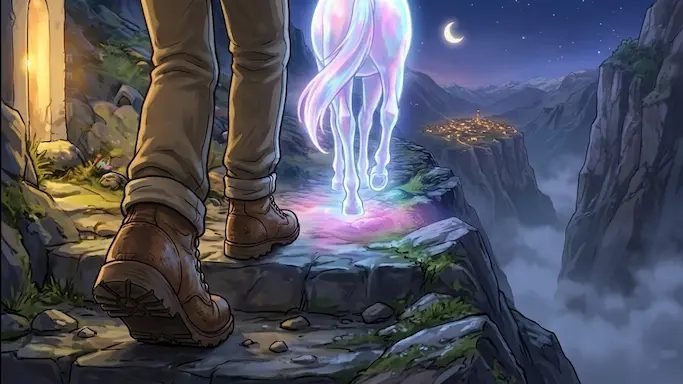
From the mist, as if shaped by the moon itself, emerged a horse.
Its coat was pure white, glowing faintly against the darkness. Its mane moved softly, though no wind touched it, and its eyes held a calm, knowing presence that stilled the traveler’s fear. The animal stood before him, neither threatening nor afraid, simply watching.
The traveler did not move.
After a moment, the horse turned without a sound and began to walk away.
Something deep within urged him to follow.
He rose slowly and stepped after it, placing his trust in this silent guide. The horse moved with quiet certainty, choosing paths hidden from ordinary sight. It led him along narrow ridges, across uneven ground, and through passages he would never have found alone. Where the rocks were dangerous, it stepped lightly. Where the way was steep, it slowed, as if aware of his every step behind it.
The traveler followed without speaking, his fear slowly giving way to a strange sense of calm.
Time passed without measure. The moon climbed higher, casting silver light across the mountains, and little by little, the cold began to ease. Then, far in the distance, he saw something flicker.
Lights.
A village.
Relief surged through him. His pace quickened as hope returned to his heart. At last, he reached the edge of the village, safe and trembling with gratitude. He turned at once, eager to thank the creature that had saved him.
But the path behind him was empty.
The white horse had vanished without a trace.
There were no hoofprints, no sound fading into the distance—only silence, as if it had never been there at all.
When the traveler told his story, the villagers listened quietly. None of them laughed. None seemed surprised. An old man nodded slowly and said that the mountains watch those who cross them, and that not all help comes from the visible world.
He told the traveler that he had passed near the shrine of Sidi Chamharouch, whether he realized it or not. Many, he said, have spoken of the white horse. Some believe it is sent by the saint himself. Others say it is a jinn, taking the form of a horse to guide the lost. But it appears only when it is needed, and it never stays once its task is done.
The traveler never forgot what happened that night. Though he returned safely to his home, he carried with him a quiet respect for the mountains and the unseen forces that dwell within them.
Even today, those who journey through the Atlas Mountains speak in low voices as they pass the shrine of Sidi Chamharouch. Some claim to hear distant hoofbeats in the wind. Others say they have glimpsed a pale shape moving through the mist at night.
No one can say for certain what the white horse truly is.
But in the high and silent places of the mountains, where paths disappear and the world feels larger than any one life, many still believe that those who are lost are never entirely alone—and that somewhere, just beyond sight, a quiet guardian may be waiting to lead them home.
________________________________________________________________________________
________________________________________________________________________________
---
Cultural Context & Heritage Insights
Origin & Folklore Tradition:
Sidi Chamharouch holds a unique place at the intersection of Moroccan mythology, Amazigh mountain culture, and popular spirituality. In the High Atlas mountains near Imlil (on the pilgrimage route to Mount Toubkal), a whitewashed rock sanctuary bearing his name draws visitors from all across North Africa. In Maghrebi folklore, Chamharouch is revered as the supreme judge and sovereign king of the unseen world.
Moral & Cultural Symbolism:
1. Impartial Justice: Unlike malevolent spirits, Chamharouch is described as a wise, fair-minded arbitrator who resolves disputes between mortals and spirits. He represents the universal human longing for absolute fairness and courtly wisdom.
2. Respect for the Unseen World: Traditional Moroccan culture maintains deep respect for nature and sacred spaces. The legend teaches travelers and shepherds to treat secluded caves, springs, and mountains with care, greeting the wilderness respectfully ("Bismillah").
3. High Atlas Sacred Geography: The mountain sanctuary embodies Morocco’s distinctive syncretism, where majestic natural landmarks become physical symbols of communal memory and spiritual storytelling.
Moroccan Cultural Glossary:
• Mahkama: The traditional court of arbitration over which Chamharouch presides.
• Qadi: A judge of high moral authority and deep legal wisdom.
• Baraka: Spiritual blessing and benevolent grace traditionally associated with Moroccan sanctuaries and respected elders.