
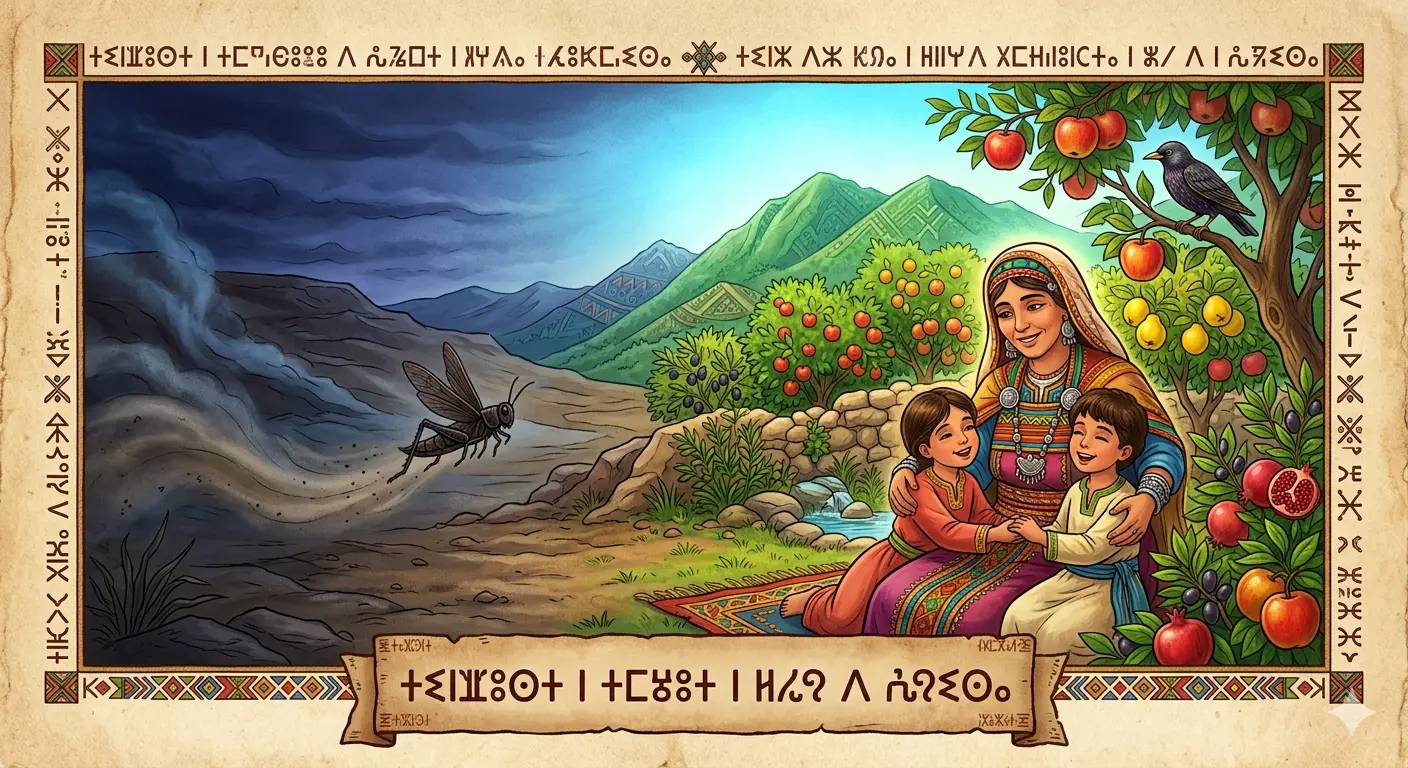
The Salty Locust
Once upon a time, in days of old, when goodness spread everywhere, when the blind could find their way even through walls, when the elderly could cross great valleys, and when a small garden—the Arsa—was enough to feed a whole tribe and overflow to the neighbors... so it was, until it was.
In a remote tribe that could only be reached through cunning and wit, the road was long and exhausting; provisions would run out long before the journey ended. The strangest thing about this tribe was that its paths never stayed the same; the road that led you there today would not bring you back tomorrow.
The secret behind all of this was a sorceress named Aqisa. She had spread her dominion over the land and its people, and her magic was so tight that only the strongest could escape it.
In that tribe lived a righteous woman, known for her generosity and kindness; she gave with her hand and comforted with her tongue. She owned a garden from which the tribe’s bounties flowed—feeding the poor and caring for the orphan—until the people gave her the title "As-Saliha" (The Righteous One). Saliha was Aqisa’s fiercest enemy. The sorceress tried every kind of magic to destroy her and ruin her garden, but God protected her and her land.
As days passed, envy burned in Aqisa’s heart like a fire consuming everything in its path. Her hatred grew even more when she saw that Saliha had been blessed with twins of breathtaking beauty, while she herself was afflicted with barrenness. She gathered her demons on a pitch-black night and said:
"Tonight, I want that garden turned to ash, so that the livestock find nothing to eat and the people find nothing to live on. I want to see Saliha humiliated, without a home, land, or food for her children."
The demons set out to execute her command, but they returned defeated. Their leader said:
"O Aqisa, God protects Saliha. We found no way into her garden; it is guarded and cannot be touched by bribe or wealth."
Aqisa thought of a new trick. Saliha had become a thorn in her side. She laughed and said:
"I have found it... Tomorrow, Saliha, you shall breakfast on tears and dine on regret."
In the morning, Saliha went to feed her children but did not find them in their beds. She touched the blankets and found them cold, realizing the deed was done at night and that Aqisa was the culprit. The tribespeople gathered in rage, saying:
"Aqisa has crossed the line! It wasn't enough to harm people; now she steals children! Let us storm her house and rid the tribe of her evil."
But when they broke into her home, they found nothing but mist and wind. She had fled after kidnapping the twins, and no one knew her path. Saliha raised her hands to the sky in prayer, and there is no veil between the prayer of the oppressed and God.
Aqisa traveled with the children until she reached the tribe of fishermen after three days—a people living by a generous river. She pitched her tent among them, but after a few days, their fortunes soured; the fish began to rot quickly, and if not eaten on the same day, even salt could not preserve them.
The people gathered, and their elder asked: "When did this begin?"
They replied: "Three days ago."
One said: "Since that strange woman arrived and pitched her tent among us."
The tribal chief declared: "This guest is an omen of ill fortune; she has no place among us. Give her provisions for the road and send her away."
They did so and expelled her. Thus, every tribe she visited, she could stay no more than three days before their life turned sour. Finally, she reached the tribe of Judge Boumiftah, known for his justice—no one was wronged in his presence, and no magic or trickery was hidden from him. He had aides among the sorcerers who worked only for good.
She settled among them, but after a few days, disputes multiplied, and the strong oppressed the weak. The Judge asked: "What has befallen our tribe?"
Someone answered: "Three days ago, a strange woman arrived with two children."
He ordered her brought before him. She claimed she was a refugee from a drought, but the Judge doubted her. He said: "I shall send my bird to bring me the news."
He had a bird that brought him information; it returned at dawn and revealed the full truth. The Judge gathered the people, the evil was exposed, and the tribe returned to its serenity. He then said to Aqisa:
"Now comes the time for punishment. Choose: shall you be turned into a frog, a locust, or a fly?"
She chose to be a locust.
In an instant, she turned into a locust and flew away. The Judge returned the children to their mother, and life returned to her after her deep grief. However, days later, swarms of locusts headed toward Saliha’s garden, led by Aqisa, intending to destroy it. But the locusts could eat nothing; they found all the fruits were salty despite their sweetness.
The people went out to hunt the locusts and ate them for days, but they found one locust that was extremely salty, so salty that no one could eat it... it was Aqisa. She remained that way until the winds carried her away and she vanished.
Since then, children have chanted:
O salty locust, where were you wandering?
In the garden of Saliha, what did you eat and drink?
You ate nothing but apples and "nfah," and wisdom is in your hands,
O Judge, O Boumiftah.