
THE YOUNG GIRL AND THE SEVEN BROTHERS
(LA JEUNE FILLE ET LES SEPT FRÈRES)
Adapted from Contes et légendes populaires du Maroc by Françoise Légey (public domain).
Retold and translated by Morocco Hykayat.
Once upon a time, there was a Queen who became pregnant, and her husband said to her: "If you have a daughter who is more beautiful than you, I shall marry her."
Now, the Queen was exceedingly beautiful and could not bear the thought of any other woman surpassing her in beauty. From that day onward, every morning she would pray to the sun and say: "Who is the most beautiful, you or I?"
And every day the sun would answer her: "I am very beautiful, you are very beautiful, but she who is in your womb is more beautiful than both you and I."
At last, she gave birth to a daughter. She immediately hid the child in the kneading trough and rolled her in the flour. Then, she went out to pray to the sun and said: "O sun, who is the most beautiful, you or I?" The sun replied: "I am beautiful, you are beautiful, but she whom you rolled in the flour and placed in the kneading trough is more beautiful than both you and I."
The Queen then raised the child, but she made a solemn promise to herself never to show her to her father. When the girl was of marriageable age, the Queen said to her one day: "We are going to go for a walk in the forest," and she led her there. Upon arriving in the forest, she prepared a bed of leaves for her and left her all alone, claiming she was going to gather wood to light a fire. In reality, the Queen fled and abandoned her daughter, of whom she was deeply jealous.
(Footnote from the original text: In Arabic, the sun is feminine. In reality, she would say: "Who is the most beautiful?")
________________________________________
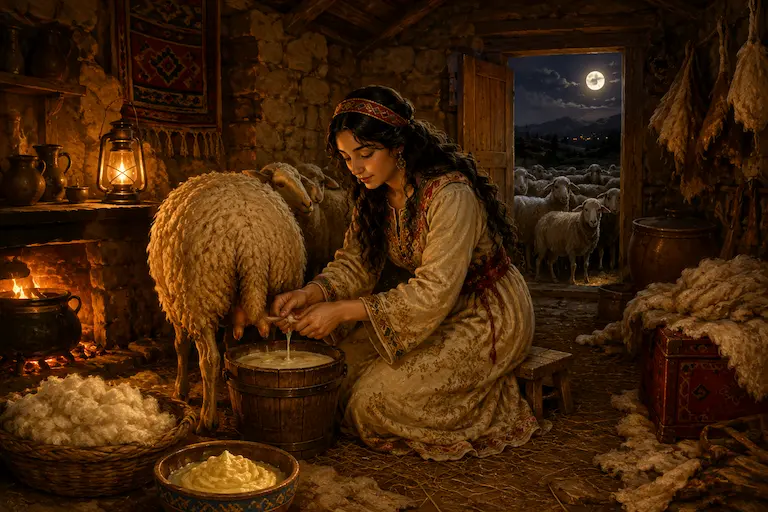
The young girl was so exhausted that she fell asleep. When she awoke, she found herself all alone and began to cry out of sheer fear. Finally, she spotted from afar a flock of sheep walking without a shepherd. She caught up with them, mingled among the sheep, and walked on all fours with them until she entered their pen, which was located in a completely isolated house; for this reason, no one saw her. The girl hid in the wool room beneath the fleeces. In truth, this house belonged to seven brothers, and this flock was theirs. The animals were accustomed to going out alone to graze in the meadows, and in the evening, they would return by themselves to the stable to sleep.
The girl remained huddled beneath the fleeces without making a sound. She heard the seven brothers return to their house, lock their door, prepare their dinner, and go to sleep.
When absolute silence reigned over the house, she emerged from her hiding place. She began to milk the ewes, made the butter, lit the fire, and kneaded the bread, preparing the morning meal. Then, she baked a little bread for herself and went back to hide.
Upon waking, the brothers were greatly surprised to see the milk in the jars, the butter in the pots, and the breakfast perfectly cooked. They all said: "We shall touch nothing, for there is magic in this, unless someone has slipped in here plotting to poison us." But the youngest of the seven brothers, who suffered from a skin disease (scald-head/tinea), cried out: "As for me, I shall eat of everything, for it looks very appetizing, and if I fall ill, so be it!" And he began to eat. The seven brothers then went out as usual, and when the young girl was certain of their departure, she came out of her hiding place, did the cleaning, cooked, ate her breakfast, and went back to hide once more.
In the evening, the brothers said: "We must stay awake tonight, each in turn, to discover the cause of all this."
They began their watch, and each night, one of the seven brothers would stay awake. But whenever sleep overcame the watchman and he fell asleep, the young girl would emerge from her hiding place and devote herself to the housework.
Finally, it was the turn of the youngest brother, the one with the skin disease. To stay awake, he roasted grains of wheat, mixed them with pebbles, and every few moments, he would put a handful into his mouth. Each time he chewed on a pebble, it hurt his teeth, keeping him awake all night long.
While he pretended to sleep, the young girl came out of her hiding place. She began to milk the ewes, make the butter, and knead the bread. While she was sitting there kneading the bread, the brother with the skin disease approached her in silence and caught her clothing from behind without her noticing, so that when she wanted to stand up, she found herself caught. At that moment, he began to shout: "I have caught her! I have caught her!" and all the brothers came running. She told them her story, and they all celebrated her and welcomed her among them as their sister. But they soon all fell in love with her and everyone wanted to marry her.
She then told them that she chose the eldest among them to be her husband, but the others refused to accept her choice. She then proposed that in the evening, she would place henna in the palm of each man's hand, and she would marry the one whose skin took on the most vibrant color from the henna stain. This proposal was accepted, and they went to procure the henna. For her part, the girl lost no time; she went to gather the small leaves of the wild jujube tree, crushed them, and mixed them into the henna of the six brothers, placing the good, pure henna only in the hand of the eldest brother.
The following day, she examined all the palms and found, to her surprise, that they were all nearly white, except for the hand of the eldest brother. Based on this consulted lot, she married the eldest brother.
One day, while she was alone, a Jewish merchant came to sell her toilet articles. She bought some jewelry from him, for which she paid generously, and then the merchant departed. He went straight to the King's city and offered his goods to the Queen.
The Queen despoiled him, giving him only a little loose change in exchange for what she took.
The merchant then exclaimed: "How ungenerous you are, O Queen, compared to Lalla Khallala Khedrâ!"—for this was the name the young girl had given herself after becoming lost in the forest. The Queen then said to him: "Where is she? And how do you know her?" The merchant recounted everything he knew.
Then the wicked Queen said to him: "I will enrich you, if you succeed in making her put this ring into her mouth." And she handed him a magic ring.
The merchant took the road back toward the dwelling of the seven brothers. He arrived there after they had gone, and offered his wares to the young girl; then he presented the ring to her, saying: "I offer you this gift to thank you for your generosity. When you go to bed, place it in your mouth and you shall see what you shall see." Without any suspicion, when evening came, the girl placed the ring in her mouth, and immediately, she fell into a deep lethargy. She looked exactly like a dead corpse. Upon waking, the seven brothers believed her to be dead. They then said: "She must be placed in a palanquin on the back of a camel, so that it may carry her as far away as possible."
They inspected their camels and asked each one: "For how long will you be able to carry her without stopping your march?" Some said for thirty years, others forty years, fifty years, a hundred years; finally, the oldest camel, who did not show her age despite her advanced years and was called Hîla (the Cunning/Resourceful One), said: "As for me, I shall carry her until the Day of Retribution."
Then, they placed a palanquin made entirely of velvet and silk onto the back of Hîla, tied the young girl securely inside, and released the camel, who set off rushing faster than the wind despite her old knees.
She went so fast that the silk curtains of the palanquin, having untied themselves, floated above the young girl like flags. Hîla traversed the deserts and vast expanses at full speed. At last, she crossed a plain where a King was hunting. The King cried out: "What do I see? I want this camel brought to me immediately, so that I may seize what it carries." The guards, mounted on their agile horses, tried to catch the camel, but they could not succeed. They returned quite ashamed to the King, who said to them: "Ignorants, do you not know that when night falls, camels stop where they are, because they are afraid of the shadow? Follow this camel from afar, and when night comes, it will be easy for you to bring her to me."
The guards set off again and galloped all day long. When evening arrived, the camel stopped; they caught up with her, seized her, and led her back to the King. The King detached the palanquin, and when they lowered it to the ground, they found nothing in it but a dead girl, but she was of a dazzling beauty that stole one's reason. Indeed, the King lost his senses because of her beauty. He said to his men: "We shall carry her away with us to raise a tomb worthy of her beauty."
They departed and arrived at the King's city. The body was carried into a sumptuous chamber of the palace, and the King summoned his women to contemplate her, saying to them: "Here is all my hunt, a dead girl!..." Then, seeing the prince's sorrow, the old women approached the young girl, felt her, examined her, and said: "This body is still alive. We must prepare a potion to revive this Beauty."
They prepared the potion and wanted to introduce it drop by drop into the young girl's mouth. There, they found the magic ring, removed it, and instantly, the young girl opened her eyes and revived. The King then declared that he was taking her for himself and married her. But the young girl, who now remembered everything that had happened to her, had only one idea in her head: to rejoin her husband whom she loved.
Now, this King had six daughters. She became their friend, and one day, she said to the King: "O my master, I should like to divert myself with your six daughters. Allow us to take a ride on horseback." Because the King had recovered his reason thanks to her, he immediately had the horses prepared; they mounted their saddles and set off for a stroll. But before leaving, Lalla Khallala Khedrâ had gone, as was her custom, to caress Hîla the camel and talk with her, saying to her: "When we are in the saddle, leave the stable and return whence you came." Thus, a few moments later, the young girls saw the camel pass by, running as fast as the wind despite her old knees. They followed her and arrived near the house of the seven brothers.
It was late, the house was closed, and the seven brothers were dining sadly. Suddenly, they heard the voice of Hîla. "It is the cry of our camel!" said the brother with the skin disease. "You are mad," said the others. "Who can know where Hîla and her burden are at this hour?" But the cry was heard again. The brother with the skin disease leaped up, opened the door, and found outside Hîla and the seven young women on their mounts. Then Lalla Khallala Khedrâ, after having shed abundant tears in the arms of her rediscovered husband, said to them: "I have brought you a young bride, a King's daughter, for each of you, and we shall never separate again." They celebrated the marriages and they all lived happily with their wives, until the hour of Death.
________________________________________
(Told by Lalla El Ghaliya Rahmaniya)
(Told by the Chérîfâ Lalla Ourqiya)