
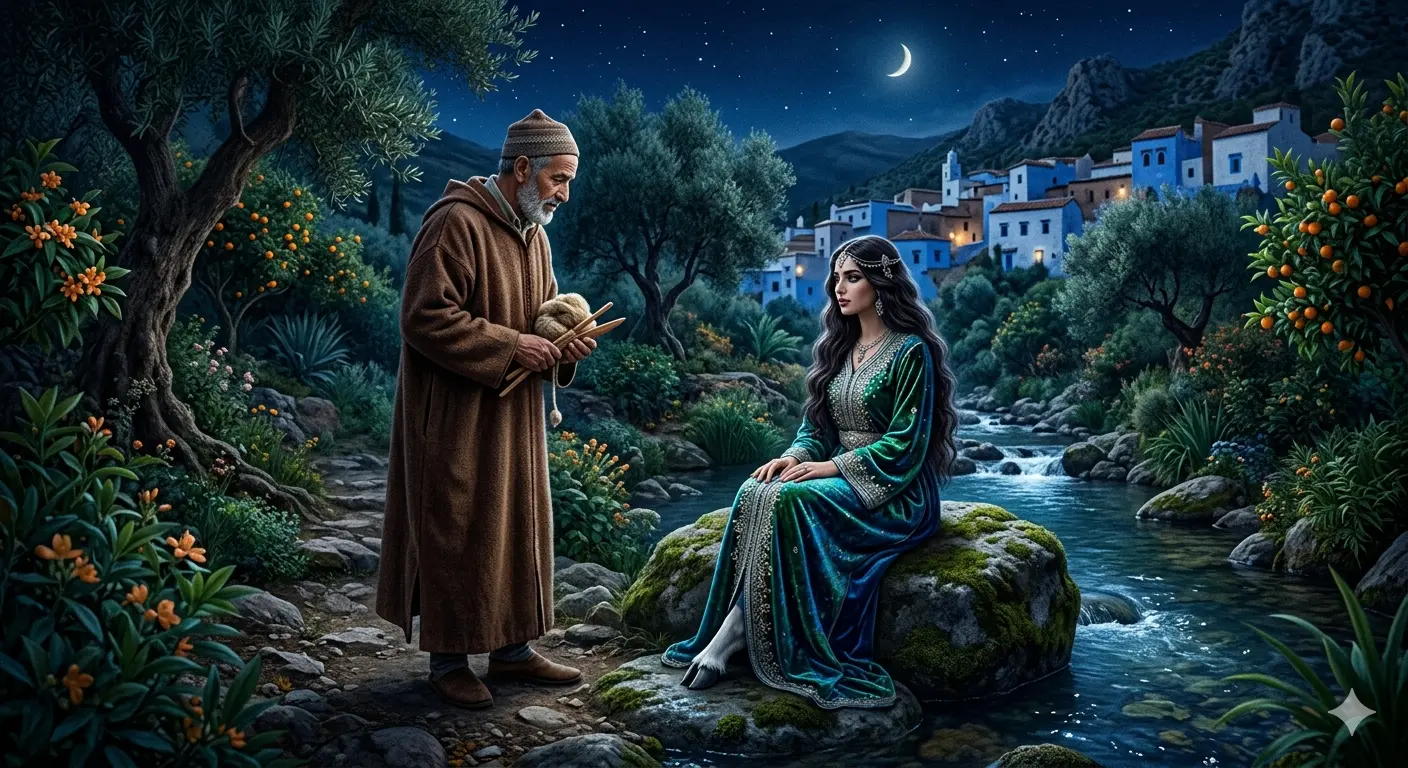
The Weaver and the Lady of the River
In the winding, blue-washed alleys of Chefchaouen, there lived a weaver named Hamza. He was known throughout the Rif Mountains not for his wealth, but for the intricate patterns of his djellabas and his unwavering kindness.
One moonless night, while returning from a distant village, Hamza found himself near a secluded stream. The air grew thick with the scent of orange blossoms and damp earth. There, sitting upon a moss-covered stone, was a woman of ethereal beauty. Her hair flowed like silk, and her dress shimmered like the surface of a lake.
The Encounter
Hamza froze. He had heard the elders’ whispers of Aicha Kandicha—the powerful spirit who could enchant any man. Some said she was a vengeful protector of the land; others said she was a test of a man’s soul.
"Why do you wander so late, Weaver?" she asked, her voice like the chime of silver bells.
Hamza bowed respectfully, keeping his eyes lowered. "I work late so that others may be warm, Lalla Aicha."
She stood, and as she moved, the hem of her robe lifted. Hamza glimpsed not human feet, but the hooves of a goat—the unmistakable mark of the spirit queen.
The Three Tests
"I have seen your work," she said, approaching him. "But beauty on a loom is easy. Let us see if you possess the beauty of the mind. I will grant you a wish if you can answer three riddles. If you fail, you shall weave for me in the underworld until your fingers turn to dust."
The First Riddle: "What is swifter than the wind, yet never leaves its home?"
Hamza smiled: "That is easy, My Lady. It is thought."
The Second Riddle: "What grows wealthier the more it gives away?"
Hamza paused: "A well of water in the desert, for the more it flows, the deeper the spring becomes."
The Third Riddle: "What is the strongest wall in Morocco, yet has no stones?"
Hamza looked at his own calloused hands: "It is hospitality. A guest in our home is safer than a king in a fortress."
The Reward
Aicha Kandicha laughed—a sound that echoed through the valley like a rushing waterfall. "You have the heart of a true son of this land," she declared.
She reached into the dark water of the stream and pulled out a handful of what looked like wet mud. She pressed it into Hamza’s palms. "For your wisdom, may your loom never run dry."
By the time Hamza reached home, the mud had transformed into pure, shimmering gold thread. He never became a greedy man; instead, he used the thread to weave the finest garments for the poor, ensuring that no one in his village ever felt the winter's chill again.
Why This Story Works for Your Audience:
Cultural Icons: Aicha Kandicha is the "superstar" of Moroccan folklore. Including her immediately grounds the story in authentic tradition.
The Moral: It highlights Moroccan values: hospitality (Diyafa), intelligence, and charity.
Atmosphere: It uses sensory details like the blue walls of Chefchaouen and the scent of orange blossoms to transport the reader.
___________________________
About the story:
Traditional Moroccan Folktale
Region: Middle Atlas
Adapted & Edited by
Morocco Hykayat Editorial Team
Reviewed by
Abdou Abdellah