
The Little Shepherd
A Moroccan Folk Tale — Author Unknown
Once upon a time, in a small, quiet village nestled between the Atlas Mountains, lived a young shepherd named Youssef. Every morning, Youssef would set out with his white sheep to the green meadows, returning at sunset singing the ancient songs of the shepherds. The villagers loved him dearly because he was truthful and honest; he never lied, nor did he ever take what did not belong to him.
Youssef lived with his elderly mother in a small mud house at the edge of the village. His mother always told him: "My son, we may not possess much money, but he who possesses honesty possesses the most precious treasure."
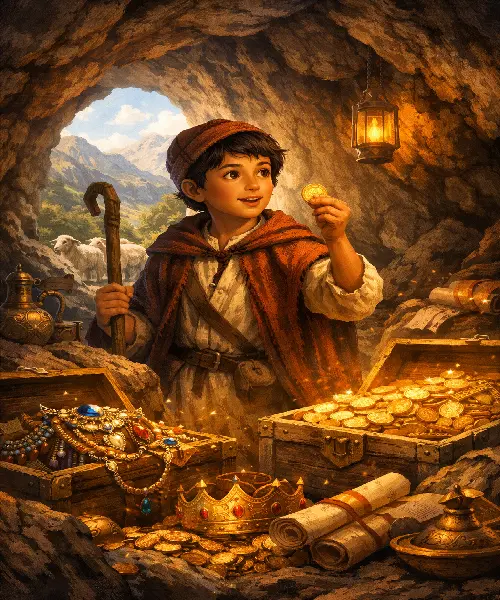
One spring day, Youssef went out as usual with his sheep. The sky was clear and the breeze was gentle. While following one of his ewes that had wandered a bit from the flock, he noticed something strange on the side of the mountain: a large, tilted rock that seemed to be hiding something behind it. Youssef approached cautiously and pushed the rock slightly, revealing a narrow opening. He leaned down and entered, finding himself inside a dark, cold cave. He moved forward slowly, touching the wall with his hand so as not to stumble. Suddenly, at the far end of the cave, he caught a glimpse of something glimmering in the dark.
He drew closer and saw old wooden chests covered in dust. He opened one of them and was astonished to find gold coins and ancient jewelry sparkling in the sunlight that filtered through the cave’s opening. Youssef stood amazed and said to himself: "How wonderful! It is a real treasure!"
But his heart was not at ease. He sat to think for a moment, remembering his mother’s words about honesty. He said: "This treasure must be from ancient times… perhaps it belongs to the people of the village or their ancestors."
Youssef rushed out of the cave and returned to the village, going straight to the Village Elder to tell him what he had seen. The Elder was amazed by his honesty; he gathered some of the village men and went with Youssef to the cave. When they arrived and saw the treasure with their own eyes, they were all struck with wonder. The Elder thought for a while and then said: "O people of the village, Youssef did not find this treasure for himself, but brought news of it to all of us. Therefore, it must be used for the benefit of everyone."
The villagers agreed to use the treasure to improve their lives. They dug a deep well for the people and travelers to drink from, repaired the road between the villages, and built a small school where children could learn reading and wisdom. As for Youssef, everyone thanked him for his truthfulness and integrity, and he became an example to be followed by both young and old.
From that day on, the people of the village would say to their children: "Gold may glitter in the eyes, but honesty shines in the heart." And so, the story of Youssef the Shepherd and the hidden treasure continued to be told on winter nights around the fire, from generation to generation, as one of the tales of Moroccan oral heritage that teaches that integrity and honesty are the greatest treasures a human can ever find.